


Managing social media for a technical blog means you're usually the only person doing it, you don't enjoy doing it, and you'd rather be writing or building something. Tools like Buffer and Hootsuite exist for this problem, but they're built for marketing teams with budgets and tend to price accordingly. Postiz is an open source alternative that takes a different approach entirely — and in 2026, that approach has gotten genuinely interesting.
What Postiz is
Postiz is an open source social media scheduling and automation platform created by Nevo David. It positions itself as an alternative to Buffer, Hypefury, and Twitter Hunter, but the more accurate description in 2026 is that it's trying to be something different from all of them: a social media tool built for the agentic era.
As of 2026, the platform supports more than 30 social networks, including X, LinkedIn, Instagram, Facebook, TikTok, YouTube, Threads, Bluesky, Reddit, Mastodon, Discord, Pinterest, and a few you might not have heard of like Warpcast, Lemmy, and Nostr.
It's open source under AGPL-3.0, self-hostable for free, and the cloud version has a 7-day trial before paid plans kick in. The codebase is on GitHub under gitroomhq/postiz-app.
The agentic angle
The word "agentic" gets overused in 2026, but Postiz earns it more than most. Where most schedulers are built strictly for human users clicking around a dashboard, Postiz is designed to be controlled by humans and by AI agents like Claude, ChatGPT, Codex, and OpenClaw through a public API, an MCP server, and a CLI.
What this means practically: you can hook Postiz into an n8n workflow that fires when you publish a new blog post and automatically schedules social posts across your connected channels. Or you can have Claude draft and schedule posts via the MCP server without touching the UI. For anyone running automated content pipelines, this is a genuine capability gap over traditional schedulers.
The CLI tool is available as a skill for AI agents. Install it, set your API key, and any agent that can run shell commands can schedule posts across 30+ platforms with structured JSON output. It works with Claude, GPT, Gemini, or open source LLMs — no SDK required.
Core features
- Cross-posting with per-channel customization — write once, tweak per platform. Your LinkedIn version can be formal and long, your X version short and punchy, Threads casual. Same draft, different voices.
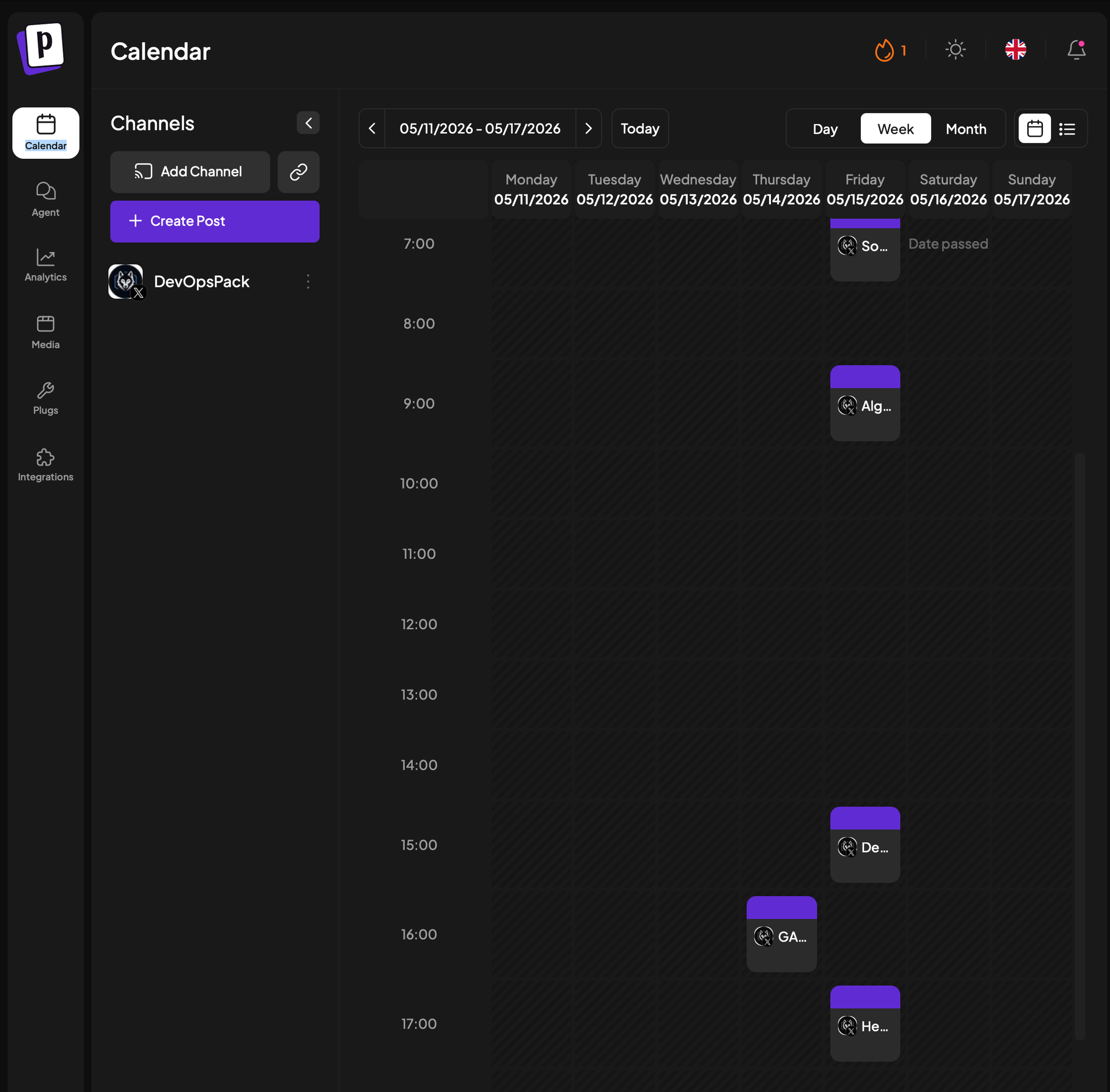
- Visual content calendar — unified calendar across all connected channels
- AI content assistant — helps with brainstorming, rewriting, and generating captions in different tones
- AI image generation — Canva-like interface with AI image generation built in, so you don't need to leave the tool
- Agent Media — script-to-video pipeline using AI actors and automated B-roll, designed for Reels and TikTok without being on camera
- Auto-actions — automatically post, like, or comment when you hit specific milestones
- Analytics — per-channel and per-post analytics pulled from each network's official API
- API + integrations — REST API, n8n custom node, Make.com integration, Zapier support, webhooks
- Team collaboration — assign tasks, leave comments, manage approval workflows
Self-hosting
Docker Compose is the recommended path. The setup requires Postiz itself plus PostgreSQL and Redis. One reviewer noted deployment friction on Coolify but said switching to Docker resolved the issue. Standard stuff — if you've deployed Ghost or any other Node.js application, Postiz is not materially more complex.
The self-hosted version is functionally equivalent to the cloud version — at the moment there is no difference between the hosted version and the self-hosted version. You get everything including the API and integrations, running on your own infrastructure.
What's missing
Postiz is a fast-moving project and it shows — in the good and bad sense. There's no mobile app as of 2026, which is a real day-to-day pain point. Analytics are basic compared to Sprout Social or Metricool. AI credits on lower plans run out quickly for heavy users. Customer support is community-driven, not phone or live chat.
Agency features — white-labeling, client management, granular team permissions — are still limited. If you're managing social for multiple clients under one account, the workflow gets awkward. This is the most cited gap in reviews from agency users.
Who it's for
Good fit: developers and technical creators who want a self-hosted social scheduler they can automate via API or AI agents, small teams managing multiple channels from one place, anyone building automated content pipelines with n8n or Make.com.
Not the right fit: non-technical users who want a simple mobile-first scheduler, agencies managing many client accounts who need white-label and client management, anyone who needs deep analytics comparable to enterprise tools.
Postiz vs Buffer vs Hootsuite
Buffer is simpler, more polished, has a mobile app, and has a genuinely usable free tier. If you just want to schedule posts to a few channels without complexity, Buffer is still the easier choice. Hootsuite is enterprise-grade and enterprise-priced — overkill for most independent creators.
Postiz wins on: open source and self-hostable, API-first design, agentic integrations, breadth of supported platforms (30+ vs Buffer's handful), and cost at scale. It loses on: polish, mobile experience, and analytics depth.
For a technical audience that already runs their own infrastructure and wants to automate their social media presence rather than manually manage it — Postiz is the most interesting option in the space right now.
Need help self-hosting Postiz?
Postiz runs well on a modest VPS alongside other services. If you want it set up properly — Docker, PostgreSQL, Redis, SSL, reverse proxy — without spending an afternoon debugging environment variables, Pipoline can handle the setup. Get in touch and we'll figure out what makes sense for your stack.



Member discussion