


Every website needs analytics. The question is which analytics tool deserves to run on yours.
Google Analytics is the default answer — it's free, it's everywhere, and everyone knows how to use it. Plausible is the alternative you keep hearing about in privacy-conscious circles. I switched DevOpsPack from Google Analytics to Plausible, and this is what I actually found.
The problem with GA4
Google Analytics 4 is a genuinely impressive piece of engineering. It can track virtually anything across web and mobile, integrates with Google Ads, runs machine learning on your data, and it's free. On paper it wins every comparison.
In practice, working with GA4 feels like this: you want to know how many people read your blog post last week. You open GA4. You stare at a dashboard that looks like it was designed for a Fortune 500 marketing team. You click through four menus. You configure a report. You wonder why the numbers don't add up. You give up and check your server logs instead.
GA4 was redesigned from the ground up in 2023 and it shows — not in a good way. The old Universal Analytics was at least navigable. GA4 is a different product built for a different user: large marketing teams running complex ad campaigns with dedicated analytics staff. If that's not you, GA4 is overkill at best and actively frustrating at worst.
There's also the privacy question. GA4 tracks users across sessions, uses cookies by default, sends data to Google's servers in the US, and requires a GDPR-compliant cookie consent banner on any EU-facing site. That banner alone costs you real conversion rate — studies consistently show 20-40% of users decline tracking, meaning your analytics data is systematically missing a significant portion of your actual audience.
What Plausible actually is
Plausible is a web analytics tool built by a small European team. It tracks pageviews, unique visitors, referral sources, countries, devices, and custom events. That's roughly it. The entire dashboard fits on one screen and updates in real time every 30 seconds.
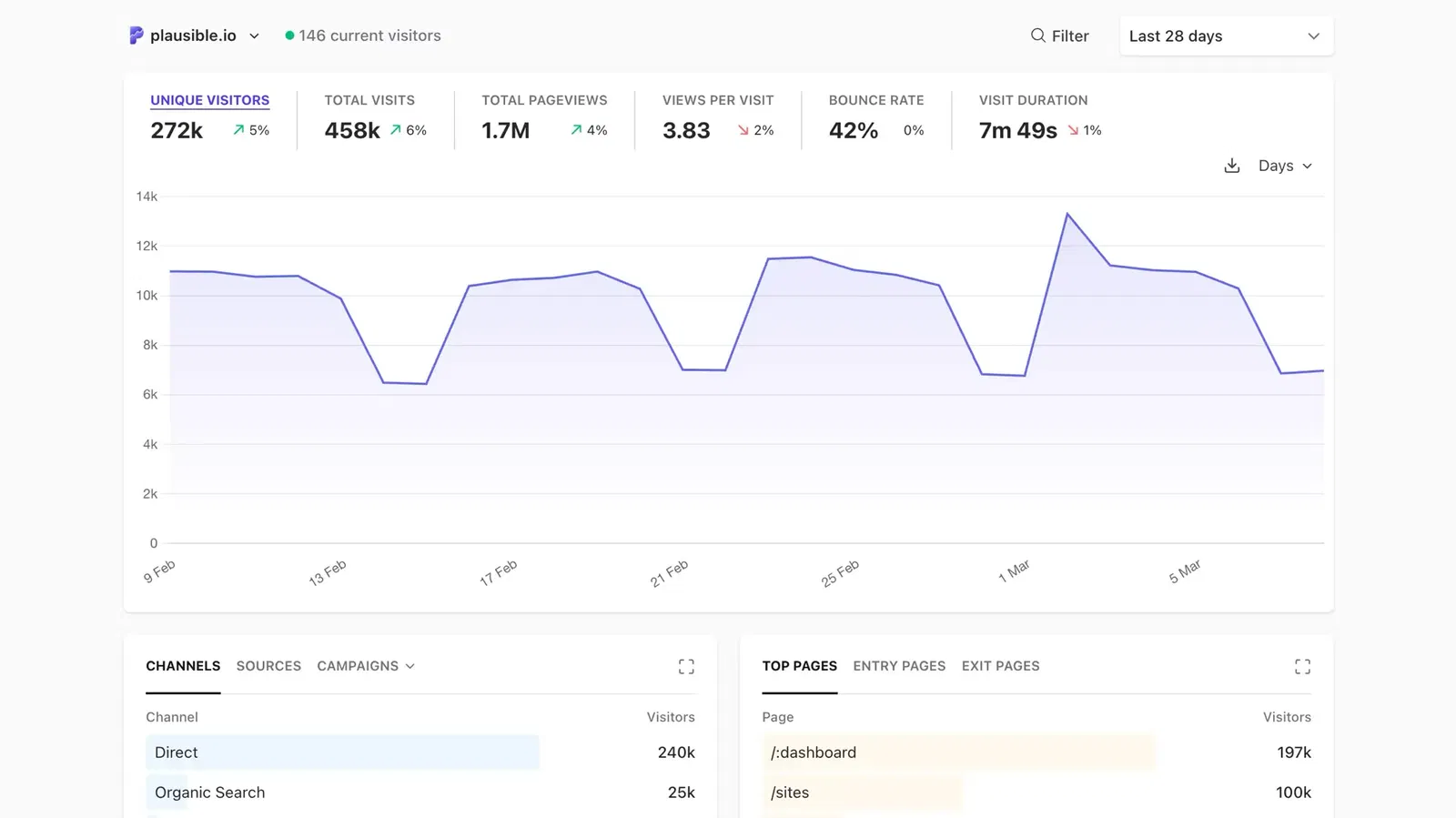
The script is 6KB — about 45x smaller than the Google Analytics script. No cookies. No cross-site tracking. No fingerprinting. GDPR, CCPA, and PECR compliant out of the box, which means no cookie banner required.
It's open source (AGPL v3) and can be self-hosted. The cloud version starts at $9/month for up to 10,000 pageviews, scaling up from there.
The honest comparison
Data accuracy
This is where Plausible quietly wins. Because it requires no cookie consent, it captures 100% of your visitors — including the 20-40% who would have declined GA4's tracking. The numbers you see in Plausible are closer to reality than GA4's numbers, even though GA4 technically collects more data per user.
GA4 also samples data on high-traffic sites in standard reports, meaning the numbers you see are estimates, not exact counts. Plausible counts every request.
Ease of use
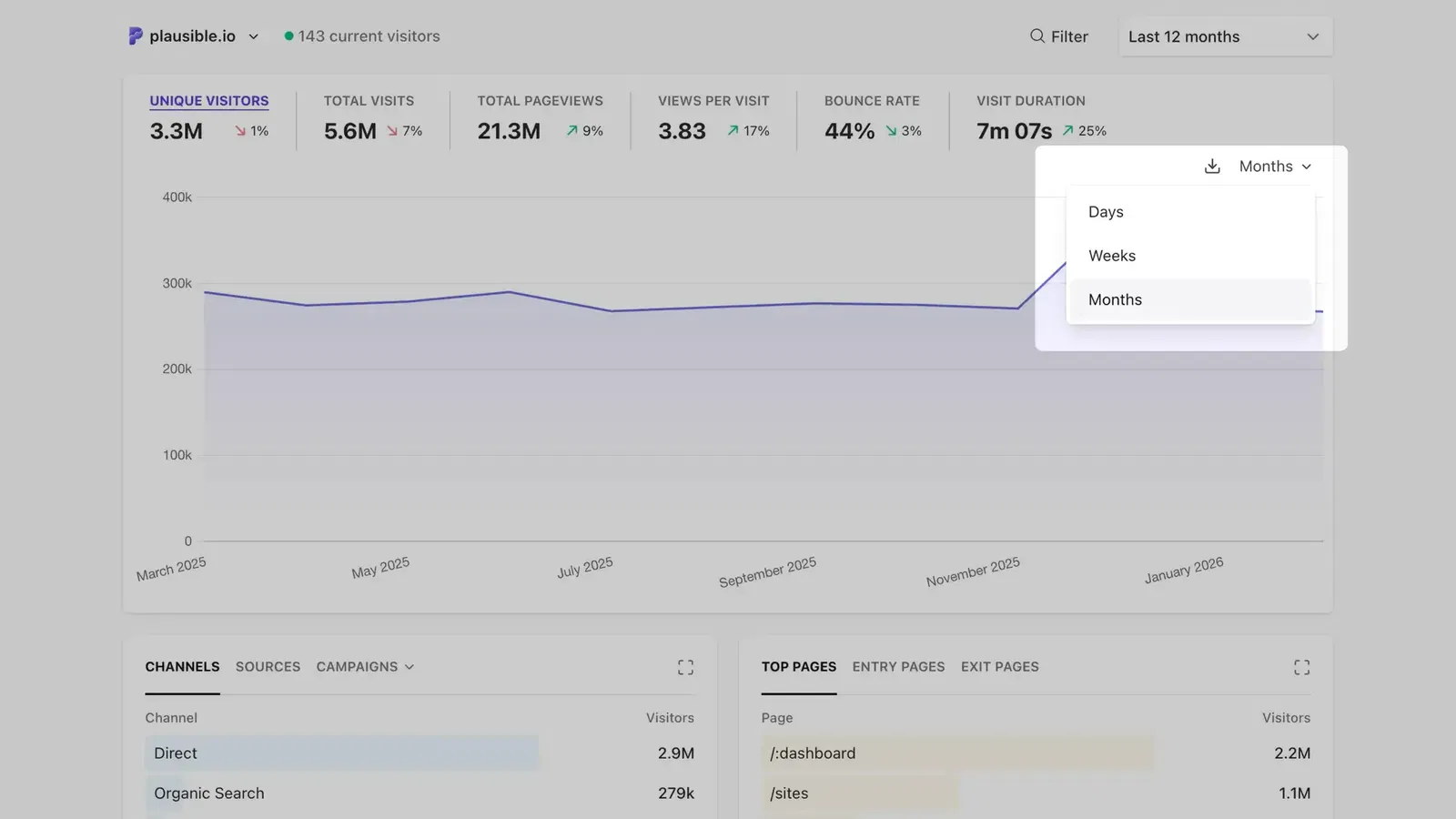
Plausible: one page, everything visible at a glance, no configuration required.
GA4: multiple pages, custom report builder, dimensions and metrics that require documentation to understand, a learning curve measured in weeks.
If you want to know "how many people visited my site today and where did they come from", Plausible answers this in 3 seconds. GA4 answers it in 45 seconds if you know where to look.
Privacy & compliance
Plausible wins decisively. No cookies, no personal data collected, no data sent to a US tech giant. Self-hosted option means your analytics data never leaves your own infrastructure. For anyone running a EU-facing site, this removes significant legal complexity.
GA4 requires consent management, cookie banners, and careful configuration to remain GDPR-compliant. It's doable but it's work.
Features
GA4 wins here — it's not close. GA4 has:
- Advanced audience segmentation
- Funnel analysis and user flow visualization
- Cross-device and cross-platform tracking
- E-commerce tracking with revenue attribution
- Google Ads integration
- Predictive metrics (purchase probability, churn probability)
- A/B testing integration
Plausible has pageviews, unique visitors, bounce rate, session duration, referrers, countries, devices, custom events, and goals. That covers 90% of what most websites actually need, but if you're running a serious e-commerce operation or complex marketing funnel, Plausible's limitations will bite you.
Performance impact
Plausible's 6KB script has essentially zero performance impact. GA4's script is heavier and loads asynchronously, but it still adds to your page weight and can affect Core Web Vitals scores — which matter for SEO.
Cost
GA4 is free. Plausible starts at $9/month. If you self-host Plausible, it's just server costs — a few dollars a month on a small VPS.
The "free" in GA4 is worth thinking about though. You're paying with your users' data and with the time you spend dealing with cookie consent infrastructure. Whether that trade-off makes sense depends on your situation.
Who should use what
Use Plausible if:
- You run a blog, documentation site, or content site
- You want clean, accurate numbers without configuration overhead
- You operate in the EU or care about GDPR compliance
- You want to self-host your analytics data
- You don't need Google Ads integration
Stick with GA4 if:
- You run an e-commerce store that depends on conversion tracking
- You run Google Ads campaigns and need attribution data
- You have a dedicated analytics person who knows GA4
- You need advanced funnel analysis or user flow visualization
- Cost is a hard constraint
My take
For DevOpsPack — a technical blog — Plausible is the obvious choice. I want to know which posts people read, where they come from, and what they click. Plausible tells me all of this in one glance. I don't need to know the predicted purchase probability of my readers.
The privacy angle matters too. Running a site that talks about infrastructure and tooling while silently funneling reader behavior data to Google feels wrong. Plausible keeps the data simple and local.
If you're building something more complex — a SaaS, an e-commerce store, anything with a real marketing funnel — GA4's feature depth becomes relevant and the cost/complexity trade-off shifts. But for most developers running their own sites or small products, Plausible is the better tool for the job.
You can try Plausible on their site, or self-host it — their Docker Compose setup is straightforward and well-documented.
Need help self-hosting Plausible?
Self-hosting Plausible is straightforward but it does require a server, a domain, and a few hours of setup. If you'd rather skip the trial and error and have it running properly from day one — that's exactly what we do at Pipoline.
We can set up and configure a self-hosted Plausible instance on your own infrastructure, so your analytics data stays yours. Get in touch and we'll figure out what makes sense for your setup.



Member discussion